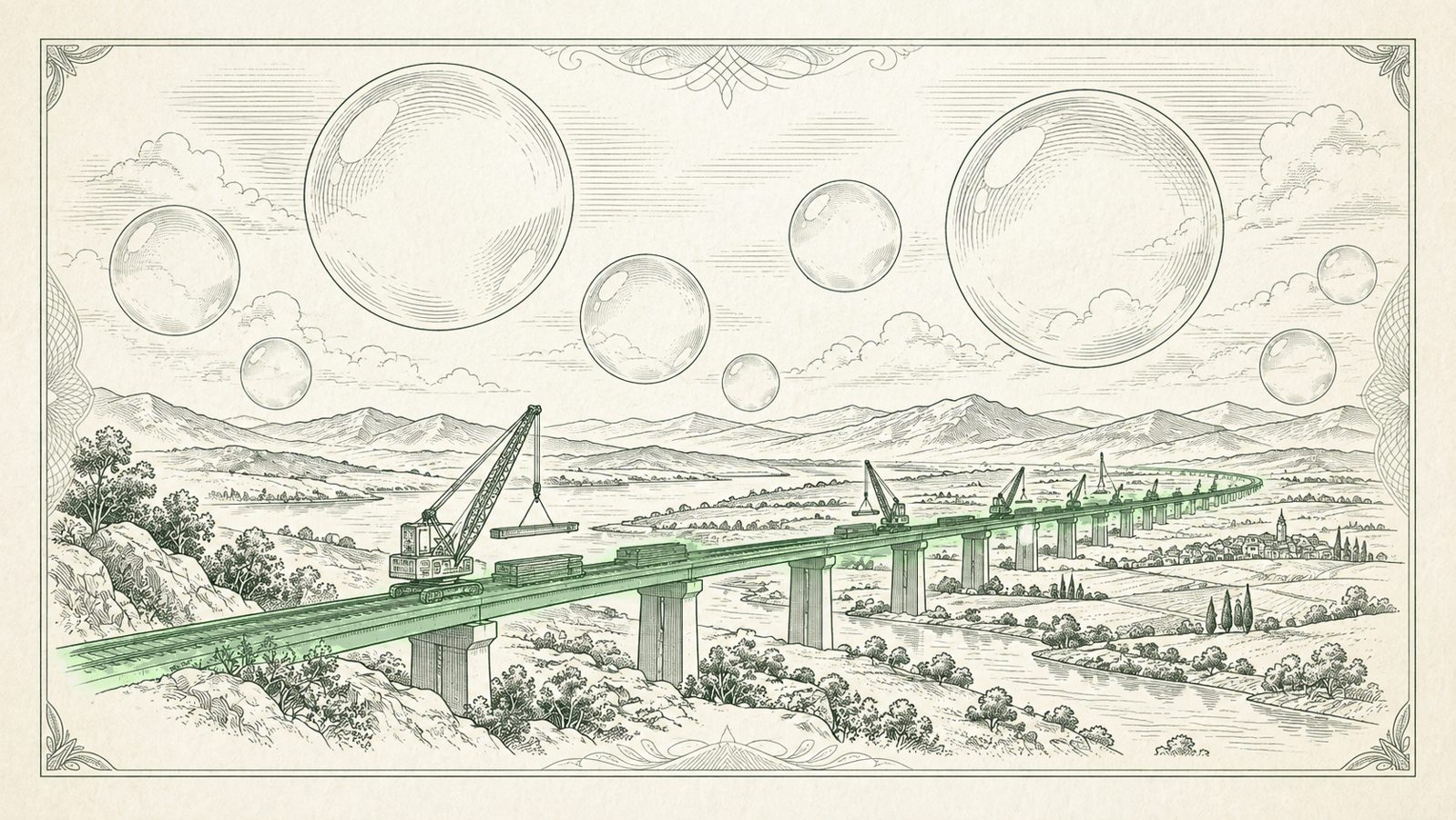
Every Great Tech Revolution Starts With a Bubble—and Why AI Is No Different
The real risk isn’t the bubble. It’s missing what emerges after it bursts.
Douglas Adams once joked that “technology is a word that describes something that does not work yet.”
He also advised: “Don’t try to understand a technology too quickly.” It’s a perfect reminder for the moment we’re living through—because nothing triggers premature certainty quite like a market boom.
Today, that boom is artificial intelligence.
AI stocks have surged to dizzying valuations, investor participation is at record highs, and index concentration has reached levels we haven’t seen since the dot-com era. The debate is everywhere: Is this a bubble about to burst? Or the beginning of a multi-decade supercycle?
But history, and a bit of Adams-style satire, suggests the answer isn’t binary. It’s yes—and yes.
The Boom–Bust–Adoption Pattern
Every major technology—railroads, automobiles, electricity, the internet—has followed the same script:
- Hype and explosive growth
- A painful correction
- Broad economic transformation
What Gartner calls the “hype cycle,” markets repeatedly experience as euphoria, disillusionment, and then real value creation. AI is no different. The correction will come—not because AI is overhyped, but because every transformative innovation overshoots before it stabilizes.
The key is recognizing that the correction is not the end of the story. It’s the clearing mechanism that allows the real winners to emerge.
In 2003, while investors were still shell-shocked from the collapse of Nortel, WorldCom, and Global Crossing, seismic shifts were already underway. “Connected computing” would soon reshape retail (Amazon), transportation (Uber), advertising (Google, Facebook), and entertainment (Netflix)—the eventual winners were building the world while investors were still licking their wounds.
What Investors Are Missing Today
The market fixation on AI mega-caps obscures a deeper, more durable shift: a global reindustrialization cycle. AI—and the capital required to power it—is exposing massive underinvestment in:
- Electricity generation
- Transmission infrastructure
- Mining
- Energy
- Materials
- Industrial capacity
We are moving into a world where investment must rise relative to consumption. This benefits entire ecosystems that have been out of favor for a decade.
Healthcare, education, software, and financial services are accelerating their AI adoption curves. Emerging Markets—often faster to leapfrog legacy systems—may see dramatic productivity upgrades. In fact, early performance trends in EM could represent leadership emerging from the correction—not after it.
Why You Shouldn’t Fear the Bubble
A boom leading to a bust is not a flaw. It is a feature of human progress.
Corrections are moments of pain but also moments of extraordinary opportunity. The fear that dominates headlines during the unwinding of a bubble often blinds investors to the new leadership forming beneath the surface. Many of the sectors that ultimately benefit from technological revolutions are not the ones in the spotlight during the initial mania.
As Howard Marks reminds us:
“You cannot predict, but you can prepare.”
And knowing where you are in the cycle is more valuable than betting on any one forecast.
Prepare for What’s Next—not for What’s Passing
AI’s promise is real. Its long-term economic impact is likely to exceed current expectations. But the path there will be volatile, uneven, and likely punctuated by a shakeout that clears space for the next generation of winners.
Those winners will not be defined solely by who sells GPUs or models today. They will come from the companies and sectors currently overlooked—the ones quietly building the infrastructure, energy systems, hardware, compute, materials, and applied technologies that make AI possible.
When the bubble bursts, it won’t be a sign that AI has failed.
It will be the moment AI finally becomes investable.
Views are the author’s as of November 28, 2025 and are not investment advice.