

Markets are moving through a transition. Leadership is broadening,
patterns are shifting, and areas that have been out of favor are
beginning to reassert themselves. What defined the last cycle is no longer
the only place to look—that’s where opportunity starts to open up.
At Flextion, we spend less time reacting to headlines and more
time observing behavior across thousands of strategies. When you
step back, a different picture emerges. This isn’t about calling a
market top or bottom. It’s about recognizing when leadership
begins to change.
One area starting to stand out is U.S. equity income.
For years, income strategies sat in the background while capital
concentrated in growth and mega-cap leadership. But over the
long run, dividends and their reinvestment have accounted for
roughly half of total equity returns. That’s not a defensive
feature—it’s a core component of how markets compound.
What’s shifting now is how that profile fits the current
environment. Income strategies bring a different balance. They
can help smooth volatility, support more consistent returns, and
shorten recovery periods after drawdowns—all while maintaining
equity exposure. In periods of transition, that combination
becomes more relevant.

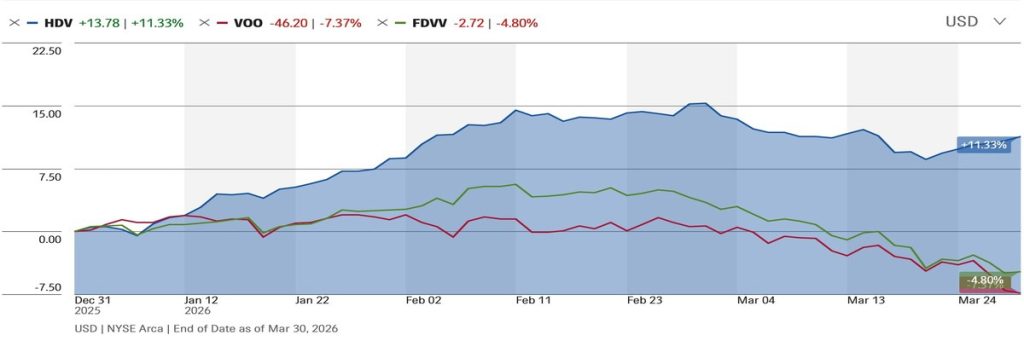
What’s particularly notable is the dispersion beneath the surface.
iShares Core High Dividend ETF (HDV) is up over 12.3% as of Fidelity High Dividend ETF (FDVV) is down around 1.8% over
March 31, 2026. the same period.
Two strategies, similar in name, delivering very different outcomes. The difference comes down to construction—not the label.
The stronger performers are diversified and balanced across sectors. Others have leaned more heavily into familiar large-cap exposures,
where yield is lower and expectations remain elevated. It’s a reminder that income isn’t defined by a label—it’s defined by how the
portfolio is built.
More broadly, this reflects a market that is opening up again. For much of the past decade, returns were concentrated in a narrow group of
companies. Today, capital is beginning to find its way into strategies built on diversification, income generation, and valuation
discipline.
A Shift That Rarely Announces Itself.
This kind of shift rarely announces itself. It tends to develop
gradually, with leadership emerging from areas that haven’t been
in focus. At Flextion, we look for those inflection points where
extended periods of underperformance begin to turn into sustained
opportunity.
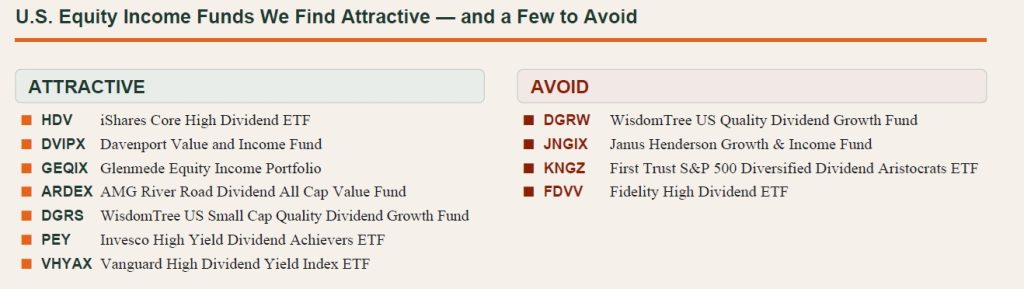
Our current signals highlight a group of income-oriented strategies
that are positioned to benefit from this shift. Others, despite
similar labels, require more selectivity.
The takeaway isn’t simply that income is working. It’s that the
market is evolving and with it, the sources of return.

Income is no longer just a complement to growth. In moments like this, it becomes a
different way to participate in the next phase of the cycle.
Insights
Download the article
About the author
Paul Ehrlichman, Flextion’s CEO and CIO, has over four decades of experience in portfolio management, leveraging fundamental and quantitative research to develop investment processes and strategies that enhance client returns and manage risks in volatile markets. He has led equity teams focused on global and international value strategies, serving a diverse client base that includes individuals, pension funds, and endowments at several leading global asset managers.


Flextion is a breakthrough platform for evaluating fund strategy returns, helping investors identify managers at a pivotal turning point—those poised to outperform after a period of underperformance. Designed by seasoned portfolio managers, Flextion bridges the gap between “clock time” and “market time,” empowering investors to unlock long-term value and uncover hidden performance potential.